 Elín Guðmundsdóttir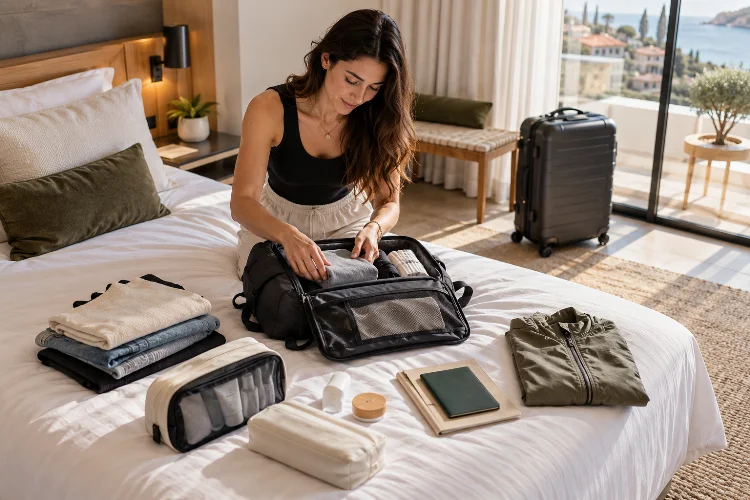
A €25 airline ticket looks wonderfully cheap until the baggage page appears.
Add a larger cabin bag, seat selection, or checked suitcase, and the final booking can suddenly cost two or three times the original fare. For travelers taking several low-cost flights, those extra charges can become one of the biggest expenses of the entire trip.
That is why using cabin bag rules to reduce low-cost airline expenses is more useful than simply searching for the lowest ticket price.
Budget airlines often include only a small personal item in their cheapest fares. The exact dimensions, weight limits, and rules vary between carriers, which means a bag that travels free with one airline might trigger an additional charge with another.
The good news is that baggage costs are partly controllable.
By understanding the strictest allowance on your itinerary, choosing the right bag, packing around dimensions rather than assumptions, and buying extra capacity only when necessary, you can keep those attractive low fares genuinely low.
Start With the Free Personal Item
The cheapest way to travel on many low-cost airlines is surprisingly simple: use only the bag included in the base fare.
Ryanair currently includes one personal bag measuring up to 40 × 30 × 20 cm, which must fit under the seat in front. A larger 10 kg cabin bag requires the relevant Priority option.
Wizz Air follows a similar structure. Its free carry-on allowance is 40 × 30 × 20 cm with a maximum weight of 10 kg, while the larger 55 × 40 × 23 cm trolley bag is available with WIZZ Priority.
easyJet is slightly more generous with dimensions. Every passenger can currently bring one free under-seat bag measuring up to 45 × 36 × 20 cm and weighing up to 15 kg.
Those differences look small on paper, but they matter when you are trying to travel without buying baggage upgrades.
Pack for the Strictest Airline on Your Trip
If your journey involves several carriers, do not pack according to the most generous one.
Pack for the strictest.
Imagine a European trip using easyJet, Ryanair, and Wizz Air. Your easyJet bag might legally measure 45 × 36 × 20 cm, but both Ryanair and Wizz Air currently limit their free personal items to 40 × 30 × 20 cm.
Using a 40 × 30 × 20 cm backpack throughout the trip therefore gives you far more consistency.
This strategy becomes even more important on complicated itineraries. Paying €20-€40 for a baggage upgrade once may seem manageable, but paying similar fees across five flight segments can destroy your budget.
Create one baggage standard for the whole trip rather than treating each flight seperately.
Understand That Dimensions Matter More Than Bag Labels
A product being marketed as a “cabin bag” does not mean every airline accepts it for free.
There is no single universal low-cost airline cabin-bag size.
Norwegian’s LowFare ticket, for example, currently includes one small under-seat bag measuring 30 × 40 × 20 cm with a 10 kg weight limit, while an overhead cabin bag is not included in that basic fare.
Vueling’s Fly Light bundle currently includes one under-seat bag of up to 40 × 30 × 20 cm. Its larger overhead bag can measure 55 × 40 × 20 cm and weigh up to 10 kg when included or purchased through the relevant option.
Before buying travel luggage, compare the actual centimeter limits of the airlines you commonly use.
A slightly smaller backpack that works across four carriers can be financially more valuable than a beautifully designed trolley case that requires an upgrade every time you fly.
Avoid Expensive Gate Surprises
The worst time to discover that your bag is too large is at the boarding gate.
By then, your options are limited.
Vueling currently states that an oversized under-seat cabin bag can cost €60–€75 per item and flight when it has to be checked at the gate. Larger unbooked or oversized overhead baggage can result in even higher charges.
easyJet likewise warns that bags exceeding the passenger’s allowance can be placed in the hold and charged an airport bag fee. Its current cabin-bag information says adding a large cabin bag online is cheaper than paying the £60 gate charge.
A cheap flight can therefore become expensive within seconds.
Measure your bag at home, including handles, side pockets, and wheels where the airline requires them to fit within the limit.
Do not rely on whether the bag “looks small.”
Learn to Pack by Volume, Not by Trip Length
Travelers often assume a seven-day trip needs twice as much luggage as a three-day trip.
It usually does not.
The biggest improvement comes from changing how you pack.
Choose clothing that can be combined into multiple outfits, wear your bulkiest shoes and jacket while flying, reduce unnecessary toiletries, and plan one laundry stop on longer trips.
A four-day wardrobe can easily become a ten-day travel system if you wash clothes once.
This is especially useful in Europe, where laundromats and accommodation with washing facilities are widely available in many cities.
The question changes from “How much can I bring?” to “How little do I actually need?”
That mindset can eliminate baggage upgrades across an entire itinerary.
Compare the Baggage Upgrade With the Fare Bundle
Traveling with only a personal item will not work for everyone.
Sometimes buying additional baggage is completely reasonable.
The important thing is comparing options before automatically adding an individual bag.
Vueling, for example, currently offers fare bundles where larger cabin or checked baggage may be included alongside other benefits such as seat selection.
Wizz Air similarly sells bundles as well as standalone baggage and Priority options.
Suppose a basic fare costs €35 and adding an overhead cabin bag costs €28.
A higher fare bundle costing €55 might include the bag plus another service you actually need.
In that situation, the bundle produces a better comparision than simply adding baggage afterward.
Always compare the final basket price.
Do Not Confuse Weight Limits With Size Limits
Travelers often focus heavily on kilograms while forgetting dimensions.
Both matter.
Wizz Air’s free personal item currently has a 10 kg maximum, while easyJet allows its free small cabin bag to weigh up to 15 kg.
But even a lightweight bag can violate the rules if it is too large.
A soft backpack can sometimes be easier than a rigid suitcase because it can compress when partially filled. However, stuffing every pocket until the bag expands beyond the permitted dimensions defeats that advantage.
Leave a little empty space.
That extra flexibilty also helps when you buy food, souvenirs, or small items during the trip.
Be Careful With Multi-Airline Return Trips
The baggage strategy that works outbound may not work on the way home.
Imagine flying to Spain with easyJet and returning with Vueling.
easyJet’s current free allowance is 45 × 36 × 20 cm, while Vueling’s free under-seat allowance is 40 × 30 × 20 cm.
If you buy a larger bag or accumulate souvenirs during the trip, the return flight becomes the problem.
Before departure, review every airline in the itinerary – not just the first flight.
A useful approach is creating a simple baggage note in your phone containing each carrier’s free dimensions and weight limit.
For five seconds of preparation, you can prevent a surprisingly expensive mistake.
Reduce Liquids to Protect Your Cabin-Only Strategy
Traveling without checked baggage also means complying with airport-security restrictions.
For departures from EU airports, current rules generally limit cabin liquids to containers no larger than 100 ml, placed inside a transparent resealable bag with a maximum capacity of one liter. Medicines and baby food have specific exceptions.
That can influence how you pack toiletries.
Instead of carrying full-size shampoo, sunscreen, cleanser, and other products, transfer what you actually need into smaller containers or buy certain inexpensive items after arrival.
Solid toiletries can also help reduce liquid volume.
The idea is not to make travel uncomfortable. It is to avoid checking an entire suitcase simply because a few toiletries exceed security limits.
Calculate Baggage Cost Across the Whole Trip
One baggage fee rarely looks dramatic.
The cumulative total can be.
Imagine a traveler taking four low-cost flights.
If adding an overhead bag averages €25 per segment, that luggage effectively costs €100 for the trip.
For two travelers, it becomes €200.
That amount could pay for accommodation, train tickets, meals, or another flight.
This is why cabin-bag discipline becomes especially valuable on multi-city journeys.
You are not merely avoiding one fee. You are removing a repeating cost from every flight.
Occassionally, paying for a larger bag remains the right choice. But it should be a deliberate decision based on the whole itinerary rather than something discovered at each booking screen.
Leave Space for the Return Journey
Packing perfectly on departure is only half the challenge.
Travelers almost always accumulate something along the way.
A book, clothing purchase, local food item, or souvenir can push a carefully measured bag beyond its limit.
Try leaving roughly 10–15% of your bag empty when departing.
Alternatively, decide before traveling what you would do if you needed more capacity. Perhaps you would pay for one checked bag only on the final flight, ship purchases home, or simply avoid buying bulky souvenirs.
Planning for the return journey allows you to maintain a cabin-only strategy without turning the last day of the trip into a luggage puzzle.
Using cabin bag rules to reduce low-cost airline expenses is one of the simplest ways to make budget airfare genuinely affordable.
Start by understanding exactly what the base fare includes, then pack according to the strictest carrier on your itinerary.
Measure your bag rather than trusting labels, compare fare bundles before purchasing baggage upgrades, and avoid expensive airport or gate charges by planning ahead.
Cabin-only travel does require more thoughtful packing, but the savings multiply quickly when you take several flights.
Before booking your next budget trip, check every airline’s current baggage allowance and calculate the cost of carrying more. You may discover that the most valuable piece of travel equipment is not a bigger suitcase, but a smaller bag that flies almost everywhere for free.